Astral Projection
Weekend Seminar Notes
After graduation in 1951, I moved to Cape Town and there met a reporter from the Cape Times who introduced me to Theosophy and my life was immediately changed. I became aware that my subjective consciousness was accentuated and became decidedly correlated to my everyday experiences. I suddenly became conscious of my astral body and that it needed some attention so that it obeyed implicitly the code of conduct that my will and sovereignty of consciousness demanded.
It was then that I became mindful of how useful my experiences in Egypt would be, especially with regard to the two phenomena that I have already described — the pyramids and the colourful horizons presented at dawn and sunset. I learned to order my day according to these two luminous periods of nature and meditated as far as possible during such productive times of the day.
My dream life had become very vivid, colourful and significant to me in the waking state, and I began to have experiences in which I was 'awake' during the sleep state — thereafter learning increasingly how to induce becoming alert while asleep, using the device of keeping a spiritual diary for instance. These processes helped me to write a book on the subject of out-of-body experiences (OBEs) in 1972, some twenty years later. During this intervening period, the correlations with my understanding of the pyramid were increased and I soon recognised for myself the strong relationship between the structure of the pyramid and the evening Duat[1] or Egyptian twilight. I began to be able to direct my OBEs purposefully to explore the astral world and its phenomena — and then progressively to be able to choose people, places and things toward which I might direct my emotional consciousness.
If during the 'awake' sleeping state I was rested and not fatigued, I found that I could visualise more intently. By visualisation I meant of course being able to create progressively and constructively images of my own choosing, rather than allowing them to be forced upon me by my very strong and effervescent emotions. I could choose faces of people I knew, or who had occupied spiritual positions in history or in my previous lives. The process of visualisation required much care and attention in order for it to be productive.
If I was in this sleep state but very alert, I had no sooner created a chosen image in the space between my eyebrows than I could leave my physical body and move in that direction. I found that this process involved certain basic principles which I began to incorporate in my second book, The Techniques of Astral Projection, the first being The Third Eye. It was only after this very productive period that I began to read voluminously both Theosophical works and to review my own experiences in Egypt, where I had resided off and on as a soldier for a period of six years. I looked into the ancient Egyptian gods of Isis and Osiris, and also into the structure of the pyramid — particularly that of the Grand Gallery and the shafts entering both the Queen's and King's chambers. Over the years as a Theosophist, lecturing broadly around the planet, I gained much experience meeting esoteric people and dealing with the problems of their psyches. I had also by then established a contact with a being higher than I am and recognised that this must either have been a Master or my own Higher Self.
The advent of the war in Iraq (2003) had a powerful effect on me because television showed the opening phases of it — in which allied rocket-propelled missiles hit selected targets — and it became clear that they had to be programmed to achieve such mastery of military power. What staggered me was that the programming was very similar to that which I was using in directing my consciousness within an astral body to a selected target. Indeed, if I programmed myself in advance as to what I would undertake the moment I became aware in the sleep state, it was comparatively easy — so long as I had an image of what I was trying to reach.
For instance, I would select people as far distant as Canada where I had already established close contacts with spiritual people who were organising lectures for me in their particular towns and cities. If I wished, I had no sooner visualised the person than I would immediately begin to move toward that visual picture — leaving my domestic circumstances in England headfirst and passing through the ethers as if in a kind of tunnel that exited the astral world. Much of what I am portraying here is confirmable in my book The Techniques of Astral Projection. It was as if I was in a long corridor; I would reach my target and come to a halt before it, oscillating somewhat, and thereafter have sufficient energy to retain my presence in order to prosecute whatever business intentions I had there.
It was during the latter part of my experimentation that information about eye movements (REMs)[2] during the dream state became widely known in California amidst various groups researching that field at the time. My own belief today is that eye movement — which we still retain as we follow the movement of a person in our dreams — is a throwback to the times when we were in the precincts of the astral world of our own planet, before we had learned to open our eyelids and become physically conscious in a materialising physical body.
What I am now proposing is the result of studying not only ancient texts like The Egyptian Book of the Dead, but also recent discoveries made and recorded in the research of Bauval and Hancock.[3]
It soon became clear from my studies that the Egyptians had created a zone in the astral world associated with the calculated practices of high Egyptian initiates, Pharaohs, Ministers and High Priests. In constructing the pyramid over a period of many thousands of years, the orientation of the structure on a north–south axis had been achieved through the help of star positions. The northern face of the Great Pyramid had been oriented purposefully to the Polar Star of the time; and as the construction continued, a passageway or shaft was meticulously adhered to so that architects could at any time direct their gaze toward the North Star. They did this with great love, because of the understanding they had of the purpose of what they were constructing. (Keeper of Genesis by Bauval and Hancock.)
Similarly, on the south face of the Great Pyramid a shaft was created pointing toward the beloved star Sirius — which was part of the sacred, cosmic celestial heaven in the astral world created and added to by those Atlantean Egyptians who had practised such procedures in previous lives on the continent of Atlantis. Now they had the star Sirius constantly drawn to their attention in the south shaft of the Queen's chamber. If they were by nature heterosexual, it was a loving, persistent, sacred attention that they gave to the eight-inch (20.32 cm) square face of the shaft pointing at Sirius. This enabled many of them to be able to visualise that star or its symbols in the quietness of their own homes — if not actually in the Queen's chamber itself.
It led, of course, to out-of-body experiences, and eventually — using the shaft oriented toward Sirius — they were able to project astrally with control. The result was that the religion became very powerful because its devotees were achieving the capacity to reach the astral counterpart of the Duat, the Egyptian heavenly state.
With the increased height of development of the Great Pyramid to the stage of the King's chamber, there had begun to emerge a powerful figure who took over the role of Osiris. Such initiate architects who used the southern shaft of the King's chamber were directed by the shaft toward the lowest of the three stars in Orion's Belt — the celestial counterpart in the heavens of the Great Pyramid. By now many of the initiates had died and others had taken their place, still orienting the pyramid toward its north–south axis whilst developing this capacity to join — while alive — the concourse of Pharaohs and High Priests whom Osiris had assembled in the astral heavenly world of the Duat.
With the process of reincarnation, some of the initiates who were alive while the Queen's chamber shafts were functional were able to re-establish this kind of orientation and astral projection — using what Theosophy calls the Permanent Atom[4] to rapidly restore their psychic powers. The slight difference now was that the symbols of their attention using the King's chamber southern shaft were Osiris and male respect for male. This is a natural process for evolving humanity in the ascending arc described in Theosophical development.
The picture below shows a concourse of Pharaoh and High Priest initiates who, after death, assembled in the Egyptian heavenly Duat, as recorded on the walls of some Egyptian displays.
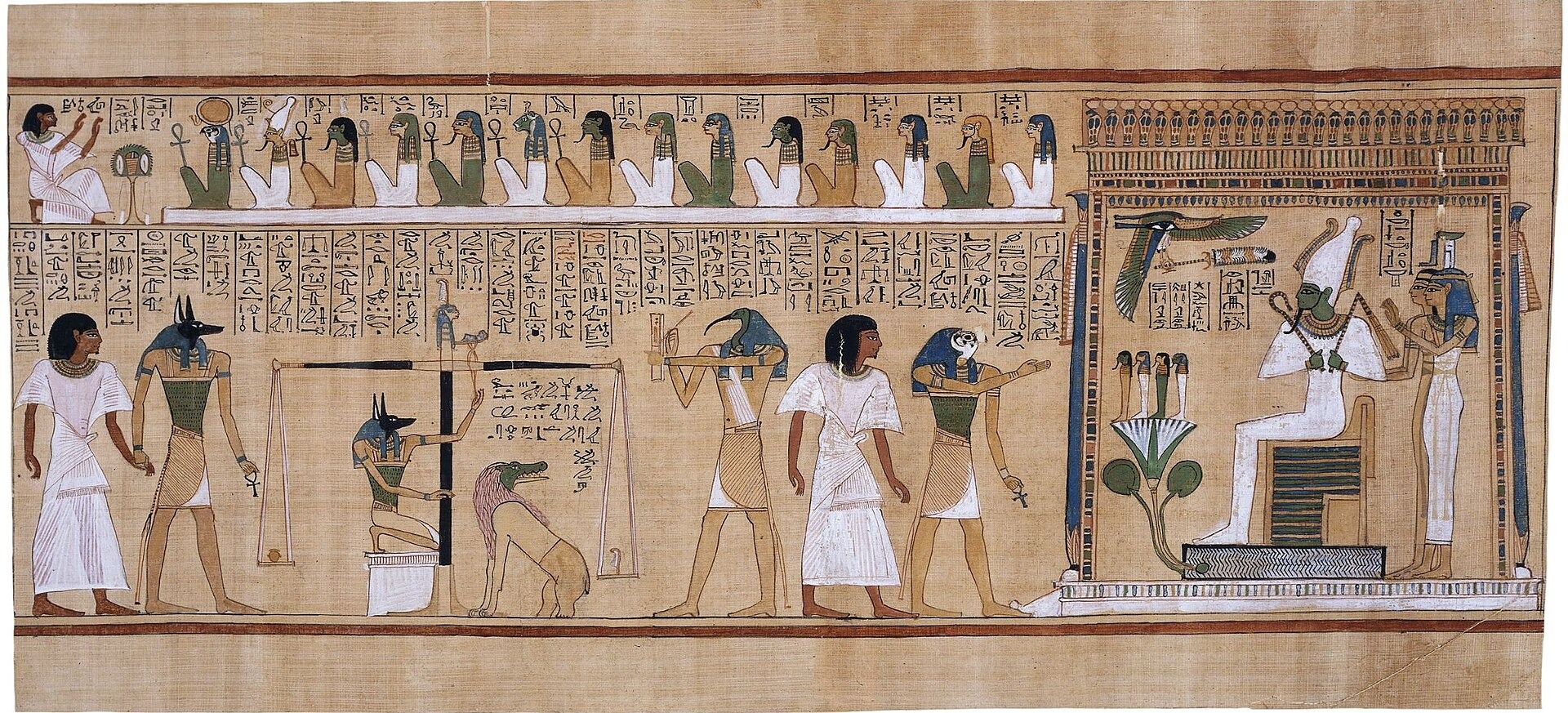
The Judgement of the Dead in the Presence of Osiris — Papyrus of Hunefer, c.1275 BC (19th Dynasty, New Kingdom). British Museum, London. Public domain.
The scene reads from left to right. To the left, Anubis brings Hunefer into the judgement area. Anubis is also shown supervizing [sic] the judgement scales. Hunefer's heart, represented as a pot, is being weighed against a feather, the symbol of Maat, the established order of things, in this context meaning 'what is right'. The ancient Egyptians believed that the heart was the seat of the emotions, the intellect and the character, and thus represented the good or bad aspects of a person's life. If the heart did not balance with the feather, then the dead person was condemned to non-existence, and consumption by the ferocious 'devourer', the strange beast shown here which is part-crocodile, part-lion, and part-hippopotamus.
However, as a papyrus devoted to ensuring Hunefer's continued existence in the Afterlife is not likely to depict this outcome, he is shown to the right, brought into the presence of Osiris by his son Horus, having become 'true of voice' or 'justified'. This was a standard epithet applied to dead individuals in their texts. Osiris is shown seated under a canopy, with his sisters Isis and Nephthys. At the top, Hunefer is shown adoring a row of deities who supervise the judgement.
A more detailed explanation of the scene can be found in the public domain The Book of the Dead, by E. A. Wallis Budge.
The Duat: in ancient Egyptian cosmology, the realm of the dead through which the sun god Ra travels each night, and which the souls of the deceased must navigate after death; the celestial counterpart of the underworld, associated both with the stars and with the journey of spiritual initiation. ↑
REMs: Rapid Eye Movements; the characteristic darting movements of the eyes behind closed lids during the dream phase of sleep, now known as REM sleep. The discovery that eye movements during dreaming track the movements of people and objects in the dream — as if the dreamer were watching a real scene — confirmed for Dr. Baker the visual and projective reality of the dream state. ↑
Robert Bauval and Graham Hancock; their book Keeper of Genesis (1996) — published in the US as The Message of the Sphinx — proposes connections between the layout of the Giza monuments, stellar alignments, and the ancient Egyptian Duat; widely read in esoteric circles. ↑
The Permanent Atom: in Dr. Baker's teaching, a minute point of energy on each of the three lower planes that persists between incarnations, carrying the vibrational record of all previous experience; the mechanism through which psychic powers and spiritual attainments are carried forward from one life to the next. ↑
