Atlantis II
In cooperation with an academic research into the volcanic sources of Atlantis, the following comment was offered:
“From my limited knowledge of Atlantic geology I think it is fair to say that everything in the account is plausible, in particular with regard to the volcanic origin of Atlantis… whoever communicated this message to your occultist has done his homework! Iceland is currently seen as an anomalously high part of the mid-Atlantic ridge, and there is really no reason why there should not have been other such areas in the past.”[1]
Such observations led Dr. Baker to point out that the diameter of the Earth (approximately 8,000 miles) would only have to expand or move outwards a distance of four miles — about 1 part in 2,000 —[2] to cause extensive upheavals, and thereby result in such a land mass as Atlantis submerging. It is hard to believe that during the period under review, which is approximately eight million years ago,[3] the Earth's diameter had not been variable to this extent.
This suggests not only the likelihood of massive inundations that were patent in the Carboniferous period (300 million years ago), the Eocene period (50 million years ago)[4] and the early Pleistocene[5] (1.5 million years ago) — see illustrations below.
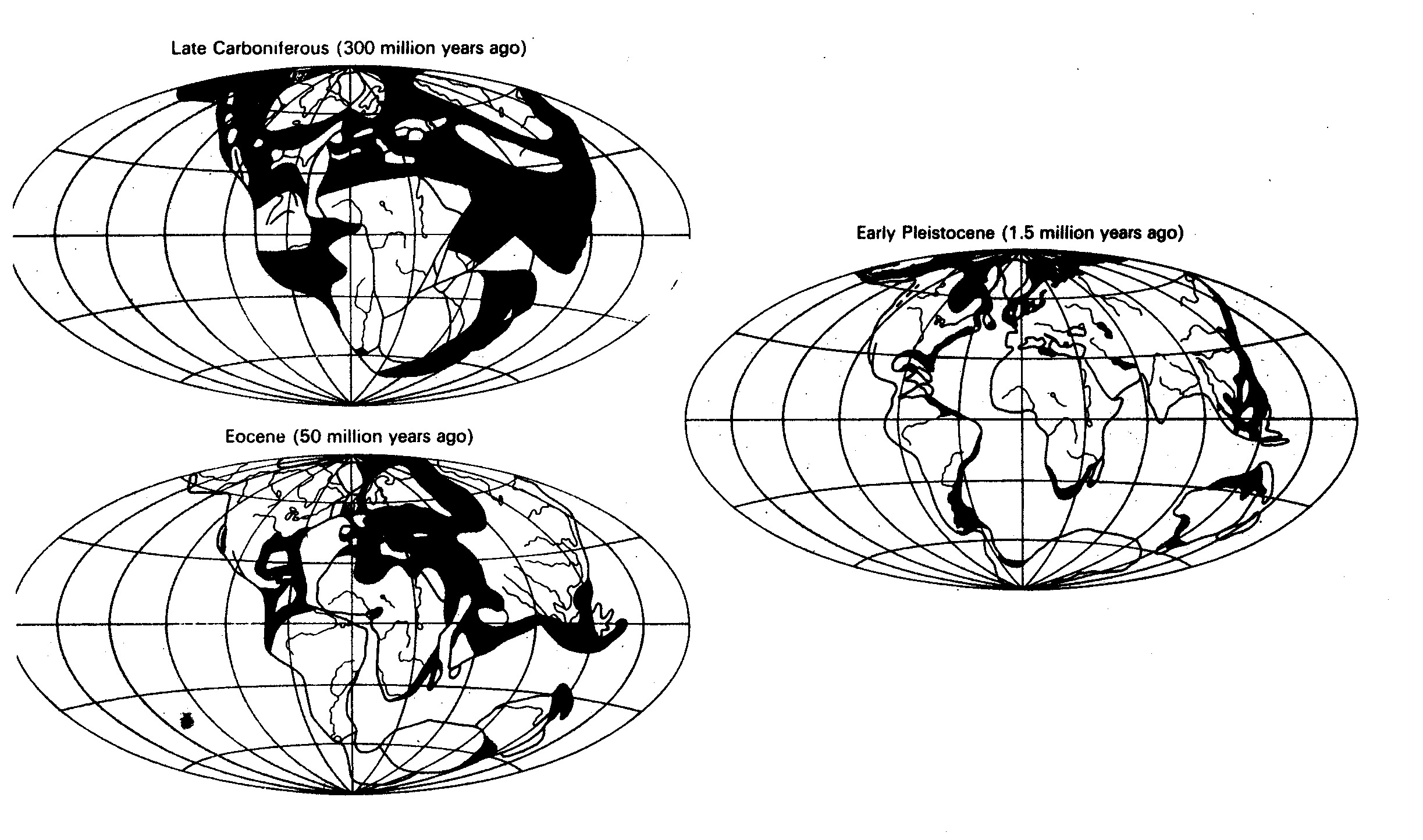
Reconstruction of the map of the world for three periods according to Wegener's theory of continental drift. Africa is placed in its present-day position as a standard of reference. The heavily shaded areas represent shallow seas. Ages in millions of years have been added. (After A. Wegener, “The Origin of Continents and Oceans,” Methuen, London, 1924)
To summarise: land masses like Iceland could have risen above sea level, and there could have been floodings like that of Atlantis.
Almost in the year that I was born, a mind-boggling theory was released by Wegener[6] called Continental Drift.[7] It indicated that continents had drifted apart from a single land mass at the rate at which human fingernails grow. Like many propositions made at the very deepest level, Wegener's was at first rejected out of hand, then reconsidered both carefully and sceptically. Finally, by the time I reached university level in my education, it was more or less universally accepted.
Transcribed by A.H., 23 August 2008 — Claregate College student
This observation comes from an unnamed academic correspondent responding to Dr. Baker's research into the geological basis of Atlantis. ↑
This 'expanding Earth' hypothesis — that the Earth's diameter has increased over geological time — was seriously discussed in the mid-20th century but is not supported by modern geophysical evidence; plate tectonics (extending Wegener's continental drift) is the current scientific consensus for continental movement and sea-level change. ↑
As transcribed, Dr. Baker gives 'approximately eight million years ago' for the period under review, but the geological periods he then cites (Carboniferous, Eocene, early Pleistocene) span 300 million to 1.5 million years ago — none of which is eight million years. Discrepancies like this are consistent with Dr. Baker's practice of thinking aloud during lectures and dictated sessions, citing figures and dates provisionally with the intention that he or his transcribers would verify them afterward — a check that, in cases like this one, evidently never took place. Preserved exactly as transcribed rather than silently corrected. ↑
Corrected from '50 billion' in the original transcript; the Eocene epoch dates to approximately 56–34 million years ago. ↑
The Pleistocene epoch began approximately 2.6 million years ago; the 'early Pleistocene' referred to here dates to around 1.5 million years ago. ↑
Alfred Wegener (1880–1930), German meteorologist and geophysicist, who proposed the theory of continental drift in 1912, suggesting that the continents were once joined in a single landmass he called Pangaea. ↑
Dr. Baker was born in 1922; Wegener's landmark work The Origin of Continents and Oceans was first published in German in 1915. ↑
