The Collective Unconscious — First Draft
Esoteric Anatomy III
(This essay was first noted down by me soon after leaving medical school, 1964.)
The collective unconscious is not a new concept. It has always been with us; it is as old as the oldest mythology, it is as ancient as the first concepts of alchemy — but we always find it fresh and new as one of the youngest of the sciences, reborn today in what we call psychology.
In our great past the unconscious was once associated entirely with Death. It was one of the sciences that dealt with access to the chthonic worlds like The Egyptian Book of the Dead and The Tibetan Book of the Dead. In Greek mythology the unconscious was where Pluto ruled and where Orpheus, pleading for the return of his Anima (Eurydice) with music, brought iron tears to the eyes and the cheeks of the Lord of the unconscious, Pluto. It was the place to which the Sirens lured men when they sailed the waters of the unconscious.
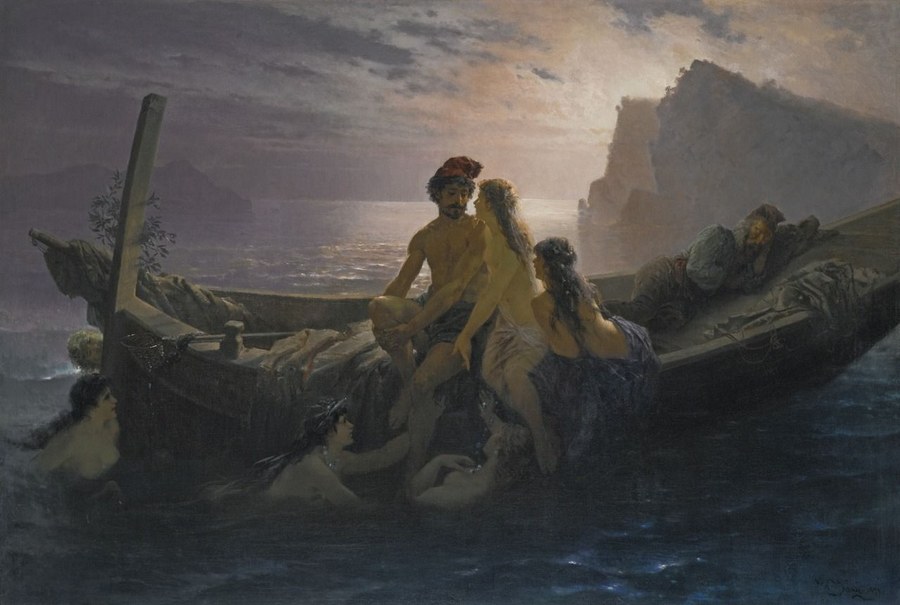
Wilhelm Kray, The Sirens (1874). Public domain.
Every great religion and esoteric doctrine described the unconscious. In its higher regions it was the Garden of Eden of the Old Testament. It was also the chosen land for the initiate few and the New Jerusalem for the Christian initiates. For the uninitiated who find life a dreary place the unconscious is the open desert, devoid of sustenance. In Theosophy it is the Hyperborean Continent,[1] at its depth a frozen wasteland while at its heights it contains the ‘imprisoned splendour’ for those who meditate, simulating globe E of our Fourth Round.[2] For those who are content only to dream it is represented by the endless symbols of water, fountains, waterfalls and nereides.
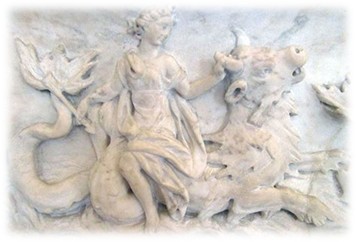
Nereid riding a hippocamp, Musée du Louvre.
The unconscious is a nothingness and a nonsense to the purely finite mind and to those who pursue only the intellectual approach. As part of the unconscious the Greeks described the psychopomp who could lead you safely into the vastness of the collective unconscious. It was the god Hermes or Mercury for the Pagan. The Western counterpart in Christianity is the risen Christ.
It is the pseudo-psychopomp when a medium is misleading you into the jungles of the purely personal unconscious where the lowest of psychic powers and their sirens, once called the Furies and the Medusae, sometimes operate as today’s mediums.
The Greek gods were the archetypes of the unconscious. They were the personifications of the qualities of the unconscious: Mars as unbridled power, Mercury as quick-wittedness, Venus as harmony and order — and the Romans copied them.
When the Christians came they merely gave the symbology of the unconscious new trappings. Archetypes became ‘spirits before the throne’; archangels fought wars in heaven. It was old wine in new bottles. The Greek Prometheus, father of mankind, stole fire from the mountaintops, home of the gods. In Judaism it was Moses confronting, in the same mountains of the mind, the burning bush — and Prometheus and Moses are estranged bedfellows in the totality of human consciousness.
The Dr. Faustus of Christopher Marlowe,[3] the Elizabethan poet, and the Faust of the German poet Goethe,[4] seduced by the devil, do not differ greatly from the fallen angel Satan from Milton’s Paradise Lost.
The onset of the Reformation and later the Industrial Revolution were two great factors important for the establishment of the unshackled growth of Western intellect and swept all these concepts of the unconscious aside. They were firstly Protestantism, which brushed aside the symbols of the Holy Roman Empire, and secondly science, which gave the death blow to myth and legend.[5] Science and materialism turned their back on the philosophical concepts of the collective unconscious — but the unconscious inexorably began to emerge in the field of medical psychology and psychiatry. In this domain both Freud and Jung had begun to investigate the unconscious before the beginning of the twentieth century.
At first their investigations had been concerned only with repressed or forgotten elements of the unconscious (a beating by a father or an indiscretion by the mother). And their researches were among their patients rather than normal individuals. Freud saw the unconscious as a very personal reflection of each individual, a gathering place for the forgotten and the repressed elements of the psyche. Jung grew beyond this; he saw the personal elements as being only a superficial layer and called it the personal unconscious. The deepest layers of the unconscious are not personal at all but universal and common to everyone.
Man, in his materialistic way, looks only outward towards objects of his desires: ‘I want that…and that…and that,’ whereas the truth is that the ultimate in objectivity lies in the world of the subjective, as I personally have found.
One sickens of this-and-that and looks for what produced them, for a causation. The more we look inward the more we realise that we are everything that exists there at our own levels of awareness and the phenomena there in the highest realms of consciousness have an inner causation. There is the highest meaning that we can seek:
Truth is there,
Beauty is there,
Goodness is there.
The ultimate and the perfect and all that Plato promised us is there.
The disciple learns to become himself, the ultimate in objectivity, by proclaiming: ‘I am that, not this, but that. I can find what is enduring within me and ultimately I am all that. I am, in fact, the Soul of all that! I am that I am.’
The enmeshment of man arises when he denies the unconscious. Excursions into intellect and science have provided healthy consolidations in his consciousness; no one denies this. But he has fallen inevitably into the great trap of materialism. He is like the fly caught in the syrup of the Venus-flytrap or the moth dashing itself to death against a hot white light. The very things that can give him further freedom to expand are denied because he shrugs off the presence of the other side of his nature, that which we call the subjective, part of which is the unconscious. Mankind needs to recover from an unparalleled impoverishment of symbolism which is being brought about by his entirely objective orientation to the neglect of his subjectivity. The belief that things must be felt, seen, smelled, tasted and measured in order to be real is absolute nonsense. The whole world of science is in disorder when it comes to considering the subject of reality because of its obsession with outer causality.
The Hyperborean Continent: in Theosophical teaching, the land of the Second Root Race of humanity; associated with a dimly conscious, semi-ethereal stage of human development. Dr. Baker uses it here metaphorically for the frozen, undeveloped depths of the unconscious. ↑
Globe E of our Fourth Round: in Dr. Baker’s Theosophical cosmology, the ascending arc of our planetary chain associated with higher astral and lower mental consciousness. ↑
Christopher Marlowe (1564–1593), Elizabethan playwright and poet; his Doctor Faustus (c.1592) is the definitive English treatment of the Faust legend. ↑
Johann Wolfgang von Goethe (1749–1832); his Faust (Part I, 1808; Part II, 1832) is one of the supreme works of world literature. ↑
This footnote marker appears in the original without a corresponding note; it appears to indicate an intended expansion on the relationship between the Reformation and the decline of mythological consciousness, not further developed in the source text. ↑
