Anu References
The Electron Described by the Dirac Equation
9701 In 1927 Dirac evolved an equation to describe the electron with four components contributing to a wave never seen before, all four being essential — but the wave was unlike Schrödinger's.
9702 Dirac's equation confirmed experimental evidence but described a particle not only with the mass of an electron but with precisely the spin of an electron and its magnetic field confirmed by experiment.
9703 In a few squiggles of his pen Dirac had described the behaviour of every single electron that had ever existed in the universe.
9704 On his commemorative stone in Westminster Abbey — iγ·∂ψ = mψ — has been inscribed by stonemasons. Some journalists thought of Dirac's equation like a golfer's 'hole in one.'
9705 Dirac thought the best way to describe the behaviours of strongly interacting particles was through equations.
9706 In 1961 Dirac conceived of the electron as sphere-shaped, a spherical bubble in an electromagnetic field.
9707 Positively charged electrons are hugely outnumbered by negative ones, which constitute a sea of negativity in which the former is a hole (the positron he anticipated).
Further Notes on the Electron — Light, Einstein, the Uncertainty Principle, Strings, Antimatter
9708 According to quantum mechanics, until you measure the position of an object it doesn't have one. It only has a 'wave function,' which is basically a description of the probability of finding the object in various positions.
9709 Quantum theory, contrary to what Einstein said about the speed of light being the maximum for anything in the universe, allows instantaneous action across huge distances.
9710 Uncertainty principle — certain pairs of quantities cannot be known exactly at the same time. If you exactly know the momentum of a particle, you can't know its position.[1]
9711 It was Dirac who conceived the electron in a quantum sense, not as a particle but as a string.
9712 Dirac believed that the path of an electron could be bent (diffracted) by a beam of light, e.g. lasers.
9713 Describing the electron in one exquisitely beautiful equation, he predicted the existence of anti-matter. It was a triumph of theoretical physics.
9714 Today, anti-matter is seen to have made up half of the matter generated at the Big Bang. These anti-matter derivations are seen to emanate from the power of pure reason.
9715 Some believed that this pure reasoning helped change the way science thought of the universe.
9716 Pauli showed that particles with no spin also have anti-particles.
Poem on the Electron — Electron Seas, Electrons, Holes, Bubbles
9717
O hear the sad petition we electrons make to you
To free us from the dominion of the hated quantum view
For we are all abandoned to its dread uncertainty.
Except by you, our champion. O pray you, set us free!
Once in a pleasant order our smooth-flowing time was spent
As the classical equations told us where to go, we went.
We vibrated in the atom, and a beam of light was freed;
And we hadn't any structure — only mass and charge and speed.
We know not if we're particles, or a jelly sort of phi,
Or waves, or if we're real at all, or where we are, or why,
To protons — holes in ether — according to Dirac.
—Anon
9718 The bizarre upshot of the theory is that the entire universe is pervaded by an infinite number of negative-energy electrons — what might be thought of as a 'sea.' Dirac argued that this sea has a constant density everywhere, so that experimenters can observe only departures from this perfect unity. If this view is correct, experimenters are in rather the same position as a tribe that has spent its entire life hearing the unchanging background sound of a single musical note: this would not seem like torture because people are aware only of changes to their environment.
9719 Only a disturbance in Dirac's sea — a bursting bubble, for example — would be observable. He envisaged just this when he foresaw that there would be some vacant states in the sea of negative-energy electrons, causing tiny departures from the otherwise perfect uniformity. Dirac called these unoccupied states 'holes.' They would be observed, he reasoned, only when they are filled by an ordinary electron, which would then emit radiation as it makes the transition. It should therefore be possible to detect a hole in the sea when an ordinary positive-energy electron jumps into it. But what characteristics do holes have? They mark the absence of a negative-energy electron. Within the general scheme of the 'electron sea,' the absence of positive energy (two negatives make a positive).
9720 'I was always taught never to start a sentence until I knew how to end it' — Dirac
Electron Holes, Force Lines — Electrons, Force Lines — Charges, the Ultimate Physical Particle?
9721 Furthermore, a negative-energy electron is negatively charged, so its absence is equivalent to the presence of a positive charge. It follows that each hole has positive energy and positive charge — the properties of the proton, the only other subatomic particle known at that time. So Dirac made the simplest possible assumption by suggesting that a hole is a proton. What he could not explain was why the proton is almost two thousand times as heavy as the electron. That was a problem for the theory, he conceded, a 'serious deficiency.'
9722 The field lines of a magnet resemble the lines of force describing the electric field of an electron.
9723 We may assume that when we pass over to the quantum theory the lines of force become all discrete and separate from one another. Each line of force is now associated with a certain amount of electrical charge. This charge will appear at the end of the line of force (if it has ends) with a positive sign at one end and a negative sign at the other. A natural assumption to make is that the amount of charge is the same for every line of force and is just the size of the charge of the electron. We now have a model in which the basic physical entity is the line of force, a thing like a string, instead of a particle. The strings will move about and interact with one another according to quantum laws.
9724 Dirac had found what he was seeking: 'a model in which a bare electron is inconceivable, because the end of a piece of string is inconceivable without the string.' But it was only the germ of an idea, not a complete new theory. Several of his students examined it but soon set it aside, as Dirac did soon afterwards. Years later, it would transpire that he had once again been ahead of his time.
9725 It was the esoteric concept of the mind — nineteenth century — that the ultimate in physical particles (or borderland) was the accumulation of lines of force into a vortex which then ramified into a complex of spirals and were then emitted as a torrent. This pulsating heart or bubble of energy was then correlated to what Hindu theosophists call the Anu.
Electron — Anu? Electricity Generators / Babbitt's Ultimate
9745 Dirac described it as a sphere — a bubble in an electro-magnetic fluid. Rather than a particle he thought of it as a wave. Babbitt saw his ultimate physical particle (below) as pulsating with negative energy entering at its vortex and positive energy emitted at its torrent. Dirac thought of the electron as a bursting bubble.
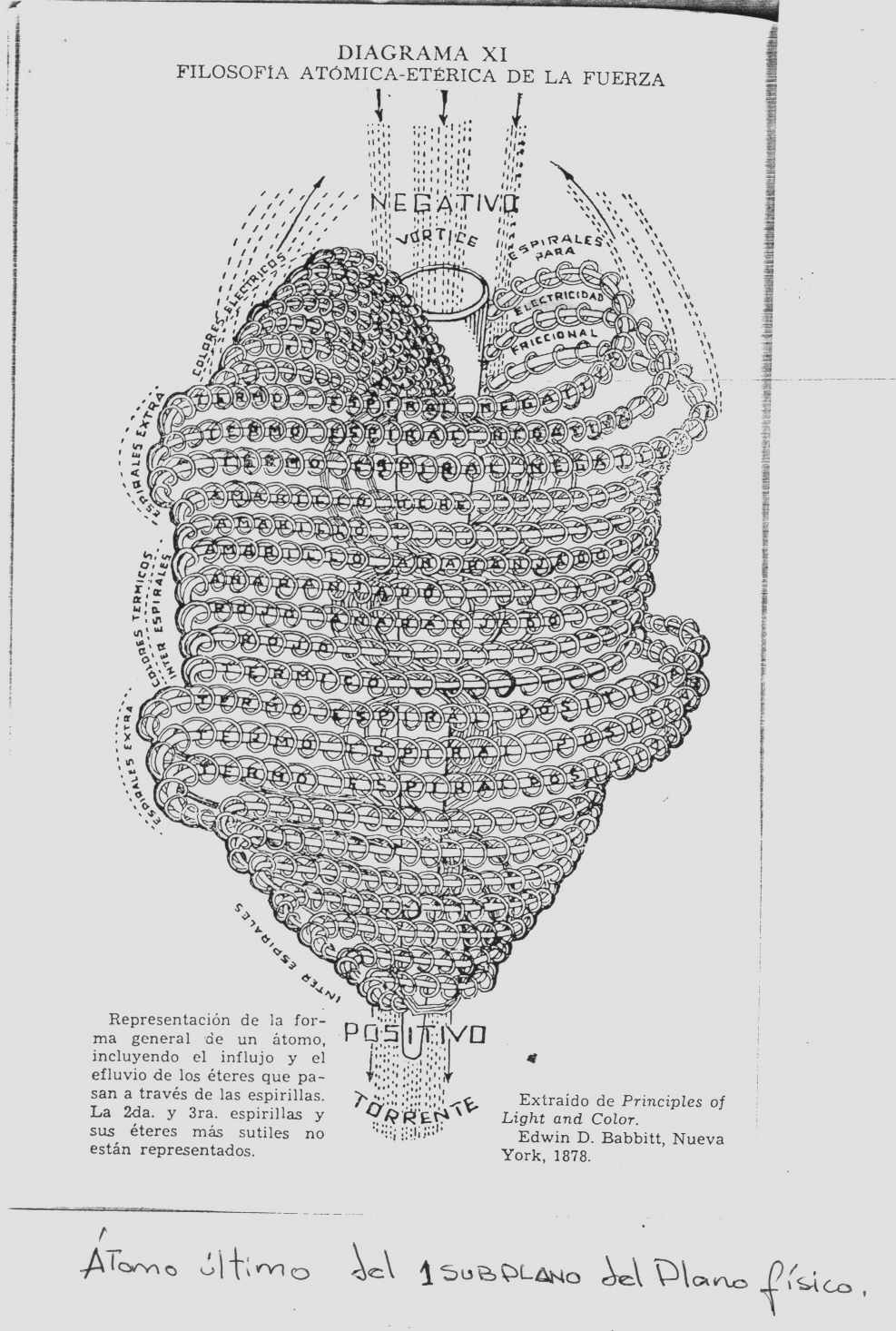
Diagrama XI — Filosofía Atómica-Etérica de la Fuerza, from a Spanish-language edition of Edwin D. Babbitt's The Principles of Light and Color (New York, 1878). A handwritten caption at the bottom reads, in Spanish, ‘Átomo último del 1 subplano del Plano físico’ — ‘Ultimate atom of the 1st sub-plane of the Physical plane.’
9747 Perhaps the turbines of the hydro-electric plants are enlarged models of the electron or the ultimate atom 'seen' by Babbitt (above) — our generators may be fabricated electrons drawing on a sea of negativity.
9748 Perhaps the molten iron core of the Earth is the largest of all the planetary generators.
9749 The lines of force of a bar magnet, easily demonstrated with iron filings, are those that in miniature enter Babbitt's ultimate atom at its vortex and negative end.
9750 It was one esoteric contention that any atom is a single thread coiled into an energy bundle. Dirac had likened the electron to the end of a piece of string (9724).
9751 Is Dirac's electron and Babbitt's concept the same — a particle or a wave? Both might be considered in the borderland of the senses. Our senses deal with particles; our brains with waves.
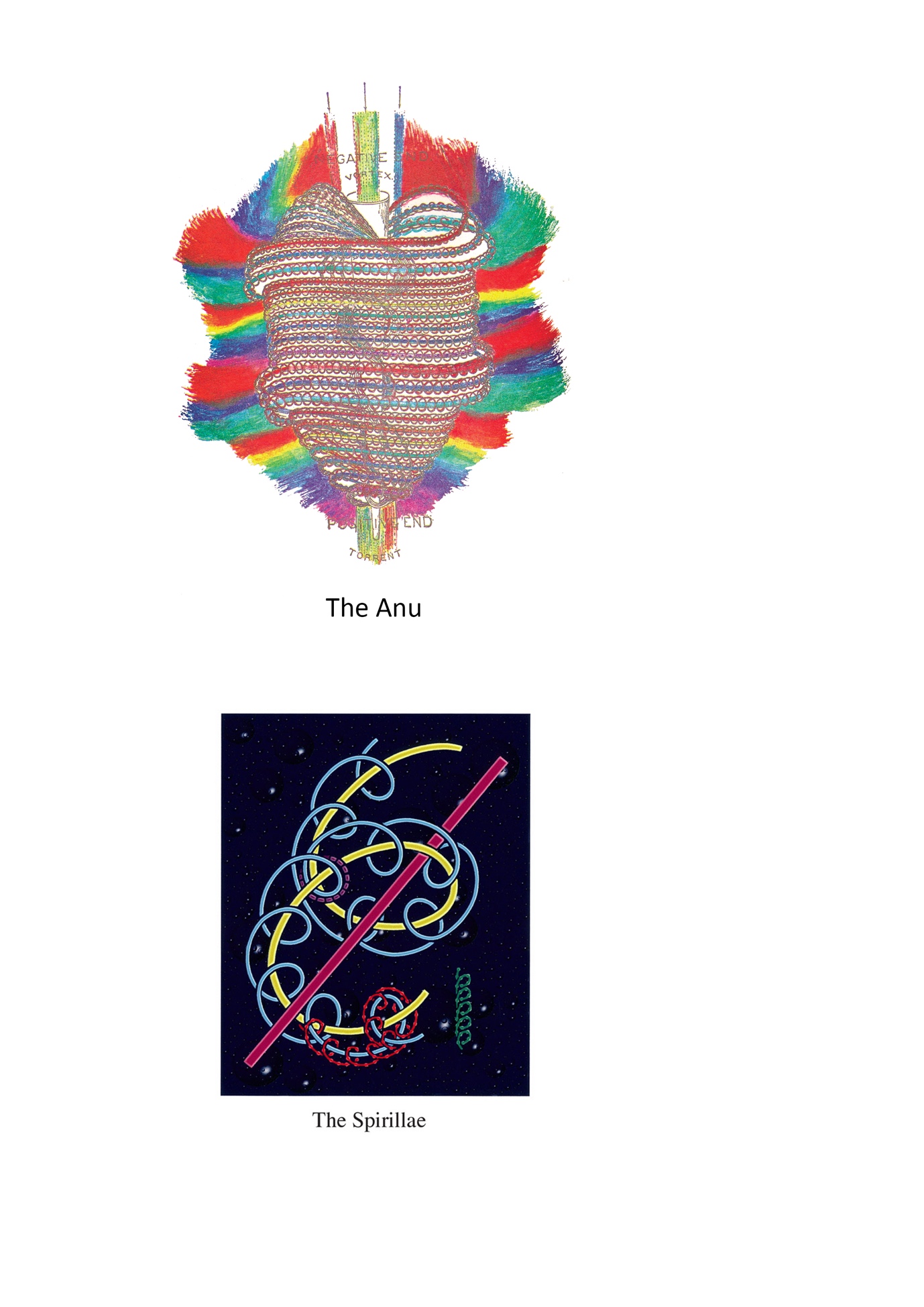
Above: The Anu and The Spirillae — illustrations included with the original document.
Formulated by Werner Heisenberg (1927). ↑
