Man’s Return to the Moon
Lecture notes for Theosophical Society Summer School
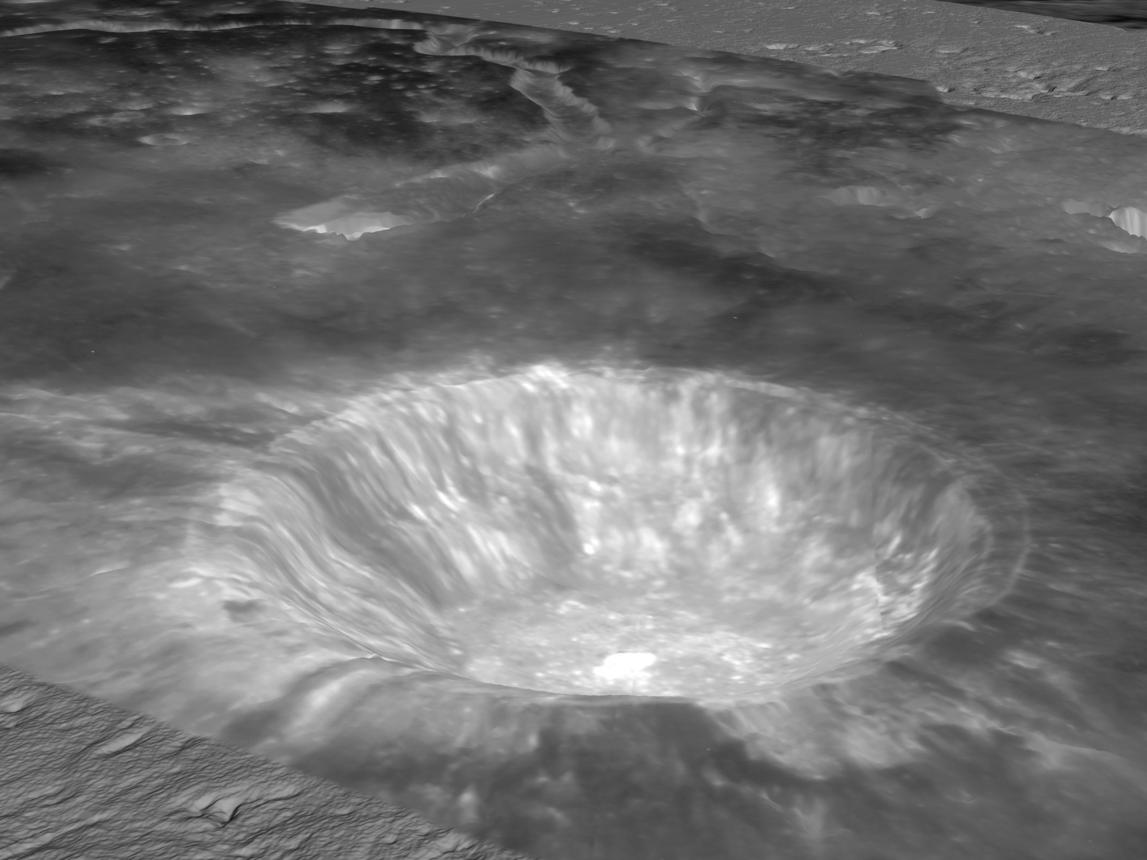
Representative image of the Aristarchus crater region, inserted in place of the illustration Dr. Baker projected from New Scientist, 29 March 2008, which is not preserved in the source file.[1]
While Man’s interest in the Moon persists, there is an unseen factor involved: we are destined to return to the Moon under the prognostications of esoteric Buddhism.
The Moon has in fact acted so far as additional globes — A, B and C — to the Earth’s Globe D. In the years ahead, increasing attention by Earth’s peoples will be directed once more at the Moon.
But this will be during the ascending arc of the Moon’s development. Man is destined to re-inhabit the Moon, charging it with oxygen and encouraging once again the establishment of the four kingdoms of nature there.
Very recently scientific attention has been drawn to the Moon because of certain phenomena that are manifesting there. Mysterious lights and explosions have been observed. [2]
The matter becomes more serious because there has been a series of sightings of lunar phenomena down through the centuries. Seven historic sightings are particularly significant, the most important of which is associated with Aristarchus — the largest crater on the Moon, which probably indicates the nature of these explosions, of which there are 15,000 or more recorded sightings.
In the tenth century, monks at Canterbury Cathedral[3] reported seeing an explosion on the Moon.
Apollo 11 astronauts reported seeing a bright glow from Aristarchus as they passed it overhead.
Unfortunately most of the sightings are reported by amateur astronomers, but out of it all it appears that six locations are firmly established as being areas of such phenomena.
The sites of these flashes seem to indicate explosions of emitted gases from one cause or another — probably coming from cracks in the surface or regolith of the Moon.
At this stage our concern is for the safety of our own astronauts, who could be injured by the convulsive, almost volcanic eruptions of these gases. The gas clouds are a few kilometres across and would persist for about ten minutes.
Where is the gas coming from? It seems to be Radon — a decay product of Uranium — and its emissions are generally radioactive.
This brings us to the esoteric implication of the phenomena. If the Moon resulted from a collision of some celestial object with the Earth, the chances are that part of the core of the Earth might have become part of the Moon.
At school as a boy I was taught that the Moon came out of the Pacific. If there is indeed a Uranium deposit on the Moon giving off Radon gases — i.e. radioactive material — it may well imply that at the core of our own planet there are heavy radioactive minerals like Uranium, and this should give us pause for concern.
Until now we have been content to believe that the core of the Earth is molten iron and we are able to manage its eruptions, which take the form of volcanoes. However, if there is some large disturbance on our planet with radioactive dense materials at the very core of the Earth, we should be very concerned.
We should remember that the Moon is receding from the Earth at the rate of approximately 3.8 centimetres per year.[4] It may well be that as the Moon moves toward the periphery of the Earth’s gravitational field it will become less stable, with its heavy metals moving within its core and letting out these gases — which are acting as a warning to us on Earth that we should be very careful in allowing nuclear tests, lest radioactive material at the core of our Earth is released in the same way that it is on the Moon.
Globe E is our responsibility, and early awareness of its danger arising as it evolves concerns us importantly.
These lecture notes reference two projected images; only one has been located and extracted from the source file. The second (also from the 29 March 2008 New Scientist article) has not been recovered. 2026-08-15: searched again for the original New Scientist (29 March 2008) chart of historic sighting sites and accompanying explosion photograph — that back issue isn't in any archive accessible here, and CJ confirmed she doesn't have a copy either. Closed as unrecoverable; the Aristarchus crater image above stands as the sole illustration for this piece. ↑
Transient Lunar Phenomena (TLP): brief flashes, glows or colour changes observed on the Moon’s surface, documented since the medieval period. The New Scientist article of 29 March 2008 referenced by Dr. Baker covered the scientific debate around their causes — principally outgassing of radon from the lunar interior, and meteorite impacts. NASA catalogued over 600 TLP events in 1968; the total recorded count now exceeds 3,000. ↑
Dr. Baker’s dictation states ‘the tenth century,’ preserved here as spoken. The account is generally dated to 18 June 1178 CE (12th century, not the 10th): it was written by Gervase of Canterbury, who recorded the testimony of five eyewitnesses who saw the upper horn of the new Moon appear to split in two, with flames and sparks spewing out. Baker's own account (‘Monks at Canterbury Cathedral’) is shorter and undated beyond ‘the tenth century’; the fuller Gervase account and corrected century are given here for the record, not as a discrepancy needing further resolution. ↑
The Moon recedes from the Earth at approximately 3.8 centimetres (about 1.5 inches) per year, as confirmed by laser ranging experiments conducted since the Apollo missions. ↑
