Is Babbitt’s Ultimate Physical Atom the Electron?
The ultimate physical particle has fascinated Theosophy for more than a century. It derives from the work of an American physician[1] and was published in The Principles of Light and Colour. The picture of the ultimate atom is too well known to require description here.
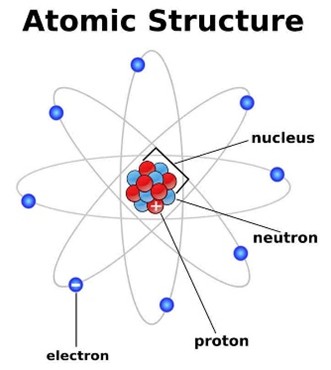
Diagram showing atomic structure with nucleus, protons, neutrons and orbiting electrons.
Atomic structure: nucleus, protons, neutrons and orbiting electrons.
- The scientific equivalent is the electron — it is the lightest known particle/wave.
- It zips through a vacuum displaying super-fast trembling motion.
- This motion was discovered in 1930 by the Austrian physicist Erwin Schrödinger.
- The motion is Zitterbewegung.[2]
- Schrödinger, a founding father of quantum theory, showed that the electron is associated with a whole new set of sub-atomic particles called antiparticles,[3] with properties opposite to those of known particles.
- Schrödinger found that as the electron flies through a vacuum at near the speed of light it undergoes a curious jittery motion.
- Because the motion of the electron is mind-boggling, nobody has actually observed it. It flits back and forth a billion, billion, billion times a second.
- The phenomenon of micro-particles produces a vacuum of seething quantum entities bursting with energy. It should be remembered that the electron plays a vital part not only in the electrical phenomena of the Earth but also inside the nervous systems of humanity itself.
- The sensitivity of the electron to energy input through its vortex suggests a quality of ‘life’ about it, meaning that it is acceptable both to the planet and to the biosphere of its living things.
Thus zero-point energy[4] not only manifests itself in the form of countless sub-atomic particles and antiparticles which pop into and out of a fleeting existence in the cosmic soup, but the electron receives from this roiling vacuum energies that are passed into its spirillae at the same time.
In 1989 Advanced Studies in Austin, Texas suggested that Zitterbewegung — the energy transferred to an electron during its buffeting of the vacuum — is represented precisely by the equation E=MC².[5]
In this equation, m is the mass of the electron — meaning that an electron has no intrinsic mass of its own, but only that derived from the vacuum during its movement.
The criteria outlined above for an electron, when applied to the ultimate physical atom of Babbitt, seem to equate with it.
Edwin D. Babbitt (1828–1905): American physician, artist and Theosophical writer; author of The Principles of Light and Colour (1878). His clairvoyant investigations of sub-atomic matter produced detailed descriptions of what he called the “ultimate physical atom” — a vortex-like particle of extraordinary fineness. DB consistently identifies this as a precursor to the modern scientific electron. ↑
Zitterbewegung: German, literally “trembling motion.” The term coined by Erwin Schrödinger (1887–1961) in 1930 for the rapid oscillatory motion of the electron as it moves through a vacuum. Schrödinger, one of the founding fathers of quantum mechanics, demonstrated that this motion is intrinsic to the electron and occurs at approximately 10²¹ oscillations per second — a billion billion billion times a second. ↑
Antiparticles: sub-atomic particles with properties exactly opposite to those of their counterparts — same mass but opposite charge. The positron, for example, is the antiparticle of the electron. When particle meets antiparticle, both are annihilated in a burst of energy. ↑
Zero-point energy: the lowest possible energy state of a quantum mechanical system, even at absolute zero temperature. DB connects this to the “cosmic soup” of virtual particles constantly bursting into and out of existence in the quantum vacuum — a model he parallels with the esoteric concept of primordial substance. ↑
E=MC²: Einstein’s mass-energy equivalence equation, here applied by the Advanced Studies group in Austin, Texas (1989) to the energy of Zitterbewegung. DB’s point is that if the electron’s mass derives entirely from its buffeting motion in the vacuum — not from any intrinsic property — this aligns precisely with Babbitt’s description of the ultimate physical atom as a vortex sustained by surrounding energetic motion rather than by any fixed material substance. ↑
