The Fourth Root Race
The Fourth Root Race developed a brilliant civilisation; the Atlanteans built cities and cultivated arts and sciences. But this proud Race “becoming with every generation more arrogant, owing to the acquisition of super-human powers, had been gradually gliding towards its end” (IV, 329).
The ending of every Root Race and its beginning with a subsequent one is always marked by tremendous geophysical cataclysms. In the case of Atlantis the cataclysms were inundations by the sea, something more than what we know as a tsunami today. Atlantis was a sub-continent not quite as large as Australia is today but it was made up of two parts.
The main part of this enormous continent was submerged several millions of years ago, during the geological period called Miocene. Some islands survived a long time, notably those called Ruta and Daitya, which perished 850,000 years ago, in the later Pliocene epoch, “after which there was no great submersion until the days of Plato’s Atlantis, or Poseidonis, as it was known to the Egyptians only because it happened in such relatively recent times” (III, 314). “Poseidonis, or the last island of Atlantis…lasted till about 12,000 years ago” (IV, 334).
This last event was recorded in the sacred books of the Egyptian temples and it is through the initiated priests of those sanctuaries that Solon, the great Athenian Sage, became acquainted with the tradition, as Plato says in the Timaeus[1]. Plato, the great initiate, had surely the exact knowledge and he confused intentionally the small island with the huge Continent, lest he might reveal a secret of the Mysteries. In his Critias, “one set of statements refers to the great Continent and the other to its last remnant: Poseidonis” (IV, 337).
Atlantis became before the final engulfment an Archipelago in which Ruta became the last surviving island. There were early warnings which the Fourth Root Race were given, indicating that the end of Atlantis was approaching. The beginnings of the population of Atlantis went back several million years but with the warnings coming as late as 850,000 years ago, attempts were being made to leave the island before the final deluge; and it is probable that some settlements of Atlanteans found useful places of further expression in South America, with pyramidal structures becoming the colonies’ main copy of Atlantean ways. In this respect, Peru developed a Mayan civilisation and Mexico an Aztec one.
Plato indicated, in information that he had obtained from Egyptian initiates during his visit to Egypt, that there had been a massive cataclysm engulfing the final islands of the Archipelago of Atlantis about 10,000 years ago. He indicated that the islands of Atlantis lay beyond the Pillars of Hercules — what we call the Straits of Gibraltar today. It was then that a group of three boats containing some 2,000 occupants made their way southwards in search of a new colonial settlement. It is traditionally believed that our map drawn by C.W. Leadbeater, the Theosophical Society clairvoyant[2], is able to reflect the route which these ships took. According to Leadbeater there was a sea stretching from Lower Egypt right across North Africa into the Atlantic. The Atlantean boats entered the sea south of Gibraltar and the Atlas Mountains. They then sailed for many weeks eastwards and, according to C.W.L., landed this side of the sea of sand which lies between the Nile and the inland sea.
Having lived in Egypt off and on for some six years during WWII I have come to the conclusion that Leadbeater may have been understandably misled in his clairvoyant perceptions, so that the Atlantean ships entered the North African sea rather near Salum and then made, still travelling eastward, for the Nile area.
The subject is fogged a little by the ancient biblical story of Noah and the flood era with all its symbolic implications, and by the fact that the most important tribes of Israel seemed to have emerged from an Egyptian area of settlement. We must however stick to the matter of Atlantean settlement in Egypt. There are many traditions associated with the collapse of the Atlantean islands which have been described by various authors in the last three centuries. We have also traditions of groups of Atlanteans, probably of the fifth sub-race, who were responsible for the founding of our own Fifth Root Race.
These were mighty men according to the Secret Doctrine. They were the Gibborim described in Hebrew traditions. The ‘mighty men’ of this passage are the Hebrew ‘Gibborim.’ In The Secret Doctrine, the Gibborim are described as:
“Those who offered fanatical worship to the Spirits of the Earth, the dark, Cosmic, anthropomorphic Power with whom they made alliance. These were the earliest Gibborim, the “mighty men of renown” in those days, who became with the Fifth Race the Kabirim, Kabiri with the Egyptians and Phoenicians, Titans with the Greeks, and Rakshasas and Daityas with the Indian races.” (III, 275).
“These are, then, the "Giants" of antiquity, the ante- and post-diluvian Gibborim of the Bible. They lived and flourished one million years ago.” (III, 339).
But we must stick to our own consideration that the last of the fleeing Atlanteans from Poseidonis were responsible for the main Egyptian civilisation as it became centred on present-day Luxor and the huge complex which we call the Temple of Karnak.
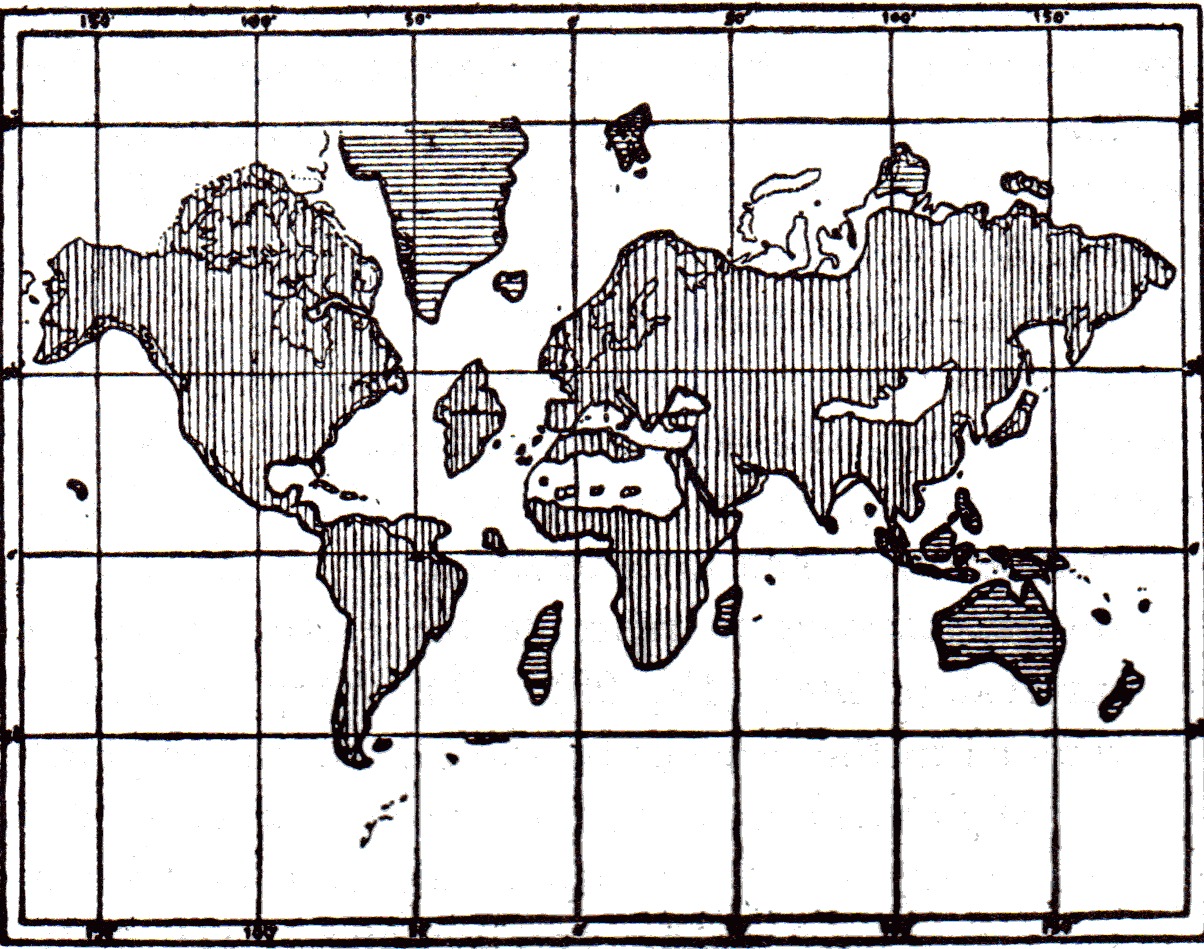
A map based on C.W. Leadbeater's clairvoyant investigations. It shows the world 75,000 years ago, including the land mass of the Atlantean islands.
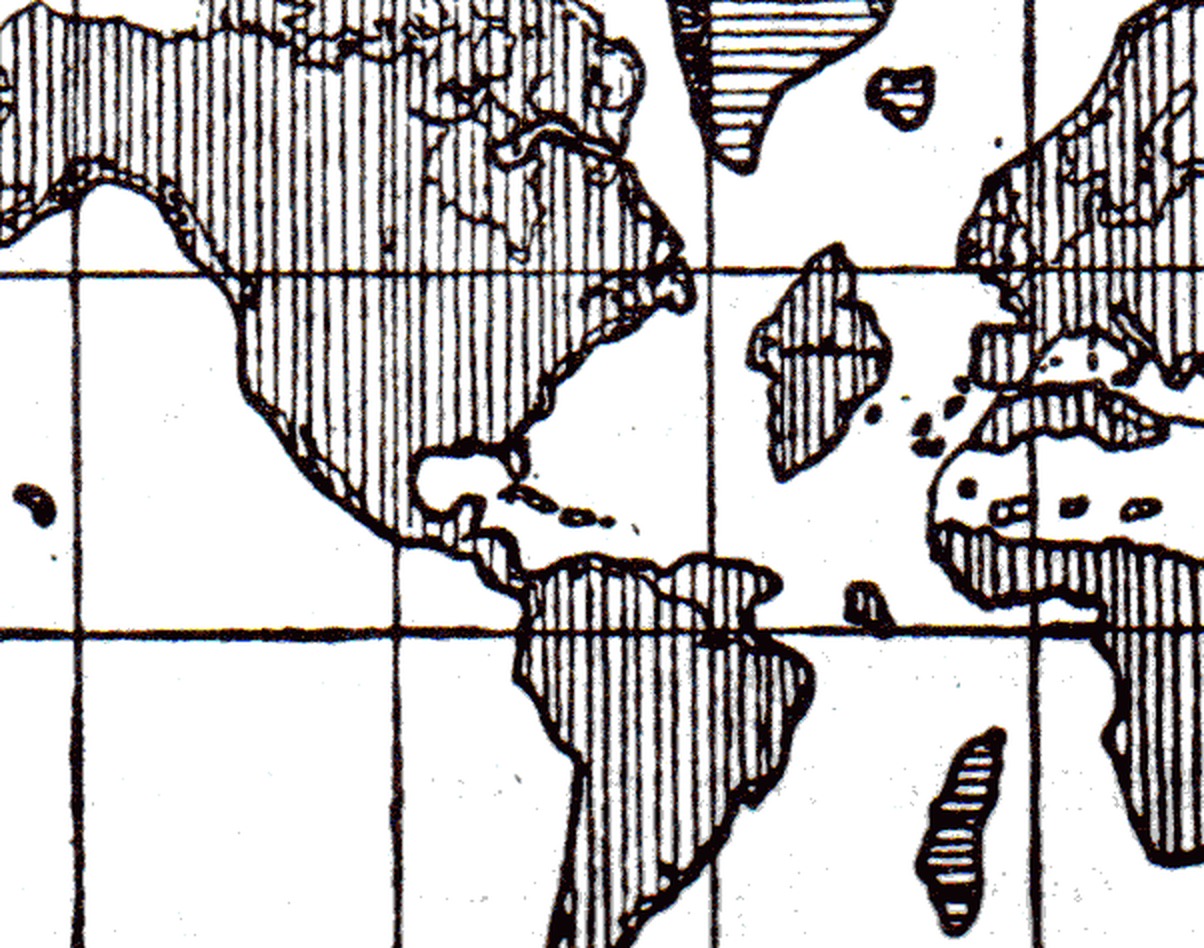
Second map — enlargement: North Africa and Atlantic region, showing the inland sea and the probable route of the Atlantean boats from Gibraltar eastward to the Nile.
The Orientation of the Great Pyramid of Cheops
The orientation of the Great Pyramid of Cheops goes back many thousands of years. Leadbeater suggests that it may be as much as 75,000 years[3]. He is of course referring to the actual beginning of it, which was a surmounting platform which eventually had the Queen’s Chamber situated in the middle of it. Work on the pyramid itself was suspended for thousands of years before building further on the platform where the Queen’s Chamber was situated. In order to orientate the pyramid accurately to the forces of nature it was polarised on an axis of North-South. To obtain the extreme accuracy required to get North and South correct, the pyramid was orientated to what was then the North Star, and the North Star was then Beta Ursa Minor.
Figure 22 (page 64) — image not located. Source: C.W. Leadbeater, likely The Inner Life or The Solar System; page 64 was believed to contain a diagram of the Great Pyramid orientation, but a copy could not be sourced for this edition.
That was the orientation at the time of the construction of the initial platform involving the Queen’s Chamber. To do this a sighting was always maintained on the star Ursa Minor. Later this orientation became a shaft constantly maintained on what was then the North Star. Today the shaft is called the Southern Shaft of the Queen’s Chamber because that is where it was viewed from.
In order to maintain orientation with Ursa Minor a shaft was constructed from the Queen’s Chamber focused on the star eternally. That is how the shaft came to be in the position that it is. Wrongfully, investigators of the pyramid have interpreted the shaft to be an air conduit, believing that fresh air was brought down into the Queen’s Chamber by these shafts. They were orientations to the North Stars, around which the pyramids were built. The southernmost point, another shaft, was similarly built and it was pointed towards the star Sirius, which has always been known as a very esoteric celestial body[4]. Sirius was due South and the Queen’s shaft pointing South as shown in the diagram as orientated.
Insert A (page 65) — image not located. Diagram of the Queen's Chamber shafts (Northern shaft pointing to Beta Ursa Minor; Southern shaft pointing to Sirius), from the same Leadbeater source as Figure 22, page 65; a copy could not be sourced for this edition.
Plato's account of Atlantis appears in his dialogues Timaeus and Critias (4th century BC), where he attributes the story to Solon's conversations with Egyptian priests. ↑
Charles Webster Leadbeater (1854–1934), Theosophist, clairvoyant and prolific author. Maps of Atlantis based on Leadbeater's clairvoyant investigations appeared in several Theosophical publications of the period (e.g. W. Scott-Elliot's The Story of Atlantis, and Besant and Leadbeater's Man: Whence, How and Whither, 1913); the specific publication Dr. Baker is referring to here could not be confirmed. ↑
Mainstream Egyptology dates the Great Pyramid's construction to approximately 2560 BC, in the Fourth Dynasty — a figure vastly at odds with the 75,000-year timescale given here, which follows Leadbeater's clairvoyant investigations rather than archaeological or textual evidence. On the star identification itself, some reconstructions of the sky over Giza c.2500 BC do place the Queen's Chamber's northern shaft in alignment with Beta Ursae Minoris (Kochab), consistent with what is stated here, while the King's Chamber's north shaft is generally associated with Thuban (Alpha Draconis). ↑
See Esoteric Buddhism by A.P. Sinnett (1883), an early and influential text of the modern Theosophical movement, on the esoteric significance of Sirius. ↑
