The Grand Gallery — Lecture Notes, 24 October 2009
The first thing that strikes you when you enter the Grand Gallery, which once provided a passage from desert level to the King's Chamber, is the amount of work that was put into its erection. The corbelling of the walls of the gallery enables its ceiling to withstand the tremendous weight of more than half the pyramid as it was erected above it. The fitting and design of the stones that line the walls of the Grand Gallery are the work of absolute mastery on the part of the stone mason.
The Purpose of the Grand Gallery
Historical Uses
What has never been adequately explained or even dealt with is what the purpose of this structure could have been to the ancient Egyptians. Its beauty, the incredible extent of labour expended upon it and its precise measurements and sophistication of its structure make it hard to believe that this passageway was created merely to bear the sarcophagus and body of a single dead pharaoh. The second suggestion has been that in order to block the entrance to the Grand Gallery and prevent robbers from despoiling its treasures and those of the King's Chamber, this required a blockage of some extent and hardness. The idea therefore arose that blocks of granite were slid down from the upper entrance to the Grand Gallery to block the outer entrance. Apart from these two there does not seem to have been any other even imaginable possible use of such an expensive item in the middle of one of the wonders of the world — the Great Pyramid, which was the first erected on the Giza plateau.
The Observatory Used on the Platform of the Truncated Pyramid
In the original erection, which itself spanned many, many years, the height reached where the Queen's Chamber is erected was initially used as an observation platform.[1] Because of its raised position it was possible to view the surrounding desert for many miles but also from the truncation to get a clear view of the stars at night. For thousands of years the platform enabled astrologers of the day to plot the apparently rotating heavens above it. Records were kept, possibly noted on the stony platform itself, but the “astronomy” of that day sought further development and the pyramid was taken to higher levels. Incorporated with this extension, the Grand Gallery was added for an obvious reason.
The reason was that it could be a kind of viewing shaft in which viewers sheltered from the crashing light and heat of the midday sun, and observational devices could be placed that would look out of the distal end of the shaft and note the rotating heavens above as the years passed.
Recondite Factors — Glass Shards
We must now draw into this subject another great recondite factor. It was that the astronomers of that day had been able to sight their many pyramids and other monumental structures on celestial dimensions of the Sun and celestial stars, such as the great zodiacal year, which took into account the greater zodiacal year amounting to 28,800 years in its cycle.[2] Where there is such proven accuracy, now dated by recent research workers, in incorporating celestial dimensions into monumental structures with such precision, we must presume these astronomers, working with even more ancient records, had the expertise to work with glass and its lenses for possible usage as a device for expanding the vision. Glass blowing was not to come for many thousands of years but nature itself had provided a very pure kind of glass way out in the Nubian Desert, some 700 km from the Nile Valley.
Nature's Glass Lenses
The endeavour of course was to create some kind of magnifying instrument that would enhance the telescopic vision of the astronomers who searched the heavens regularly for information about the “rotating” greater zodiacal year.
A — In December 1932, Patrick Clayton, a surveyor with the Egyptian Geological Society, was bumping across the dunes towards the high, wind-swept red rocks of the Saad plateau when he felt the tyres of his car crunch across chunks of glass. It was an incredibly clear, green-yellow glass that glittered like gems in the bright sun. Over the next few years he returned on expeditions to collect samples of this strange material, marking his last visit in 1934 with a simple, scribbled message that he tucked into an empty bottle and left amongst the glass[3].
B — These glittering shards are the purest natural silica glass anyone has ever found. And there may be more than 1,400 tons of the stuff spread across a vast area of the desert. Some pieces contain tiny bubbles, wispy white deposits and swirling black patterns that hint at a tumultuous origin. Where on earth did they come from?
C — “It's the purest natural glass in the world,” says Vincenzo de Michele, keeper of minerals at Milan's Museum of Natural History, “with a silica content of 98 per cent.”
D — Geologists date the glass at 28.5 million years old and have identified whitish inclusions in the glass as minerals such as cristobalite and baddeleyite — which form at temperatures far higher than those found in volcanic lava.
E — The only explanation is that the glass formed when a meteorite crashed into the desert.
This suggestion seems to make good sense. The local Nubian sandstone is rich in silica and, should you want to melt thousands of tons of the stuff, there is no better way to do it than with a large meteorite travelling at several kilometres per second. Smash it into the ground and the explosive impact would vaporise a huge area of the desert, melting rocks and sand at temperatures easily high enough to form minerals like baddeleyite. And as the molten rock cooled, it would turn to clear, green-yellow coloured glass.
F — In 1996 Negro and de Michele were wandering through the Egyptian Museum in Cairo when they spotted a tiny carved scarab, part of a piece of jewellery found by Howard Carter in Tutankhamun's tomb. The yellow-green mineral bore a striking resemblance to their mysterious desert glass. When they measured the optical properties of the scarab they almost exactly matched that of the samples of the silica glass.
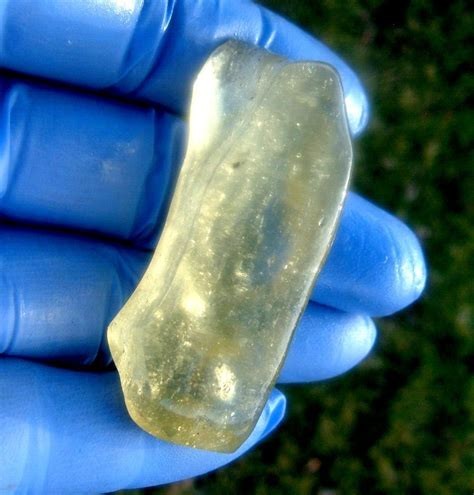
A specimen of Libyan desert glass (silica impactite) — the natural glass formed by meteorite impact in the western desert of Egypt, 28.5 million years ago.[4]
Picture shows fragments of the light-green glass formed by the meteorite striking the western desert. This kind of glass was so remarkable as to provide gemstones for the pharaohs to wear in their regalia.
The Scarab
The most admired and respected sacred emblem in ancient Egypt was of course the scarab.
G — Until the discovery of the scarab, no one had any idea that the ancient Egyptians knew about the glass or had travelled so far — almost 700 kilometres — into the desert. The scarab remains the only silica glass jewel discovered among the treasures of ancient Egypt. “Perhaps they used it as a rarity,” says Negro, “probably thinking, as Clayton did, it was a cosmic gem.”
H — The scarab beetle is found widely in Africa and especially in Egypt. It is quite extraordinary how it scavenges for food. Years ago when I was part of the British Forces in North Africa we used to daily walk out into the sandy desert wastes to exercise nature's functions, there being no convenient portable devices. Having completed the necessary function we would then proceed to bury the evidence with a spade. But before this, very frequently, according to which way the wind was blowing, scarab beetles would appear. They could be 50 yards away and immediately establish the direction of the offending wind-borne fragrance. They rushed to that area in search of the dung and whenever they located it, they would cut a piece off and roll it into a ball. Then, using their back legs, they would push the ball backwards before them to their burrows. This could then be eaten or used as a store of food for the young of the beetle when they hatched.
Insects fascinated the Egyptians. The bee, with its metamorphosis from grub into imago, especially attracted them, its changing states reminding them of the transformation which man must undergo as he passes at death from one kingdom to another. But it was the scarab beetle (Scarabaeus sacer) that really caught their imaginations and became “one of the most remarkable symbolic figures ever conceived by the mind of men. It was evolved by the erudition of the priestcraft from a simple instinct, which, because of its peculiar habit and appearance, properly symbolised the strength of the body, the resurrection of the Soul, and the Creator in his aspect as Lord of the Sun.”[5]
I — The scarab beetle was widely respected by the Egyptian populace partly because it braved the midday heat and when it spread its wings their multicoloured, metallic facets caught the sun and through them the creature became related to the sun god Ra.
So respected was the scarab that the precious green glass material from nature's meteorites was often carved into the shape of a scarab beetle.
Telescopic Vision
The various factors bring together the recondite knowledge which was presented to me. Just as the Ankh had brought to me an understanding of photosynthesis and Akhenaten's message to his priests to praise and adore the Sun rather than the animal gods previously, so too the scarab beetle and the glass deposits of meteorites helped to reveal the recondite knowledge that the Grand Gallery once contained a mobile telescope using the natural glass already described as its lenses. The Grand Gallery was uniquely constructed with regular niches enabling the telescope to be adjusted in order to reach the heavenly stars that formed so graphically their constellations; this contributed to two factors:
1) Knowledge about the repeating cycle of the greater zodiac every 25,800 years, thus providing modern esoteric astrologers with an understanding of zodiacal signs in terms of ages repeated — e.g. the Aquarian Age is upon us and knowledge of its qualities have been derived by ancient astrologers from its repeated cycles going back three orbits in the making, i.e. more than 75,000 years.
2) Some thousands of years later it was decided to centralise national authority around the Great Pyramid and it was then that the King's Chamber came into being on the now higher truncated platform that was about to be converted into the ultimate pyramidal structure. It soon became realised that the King's Chamber would have to bear the tremendous weight of the completed pyramid on its ceiling. This would involve huge fifty-tonne or more blocks in its tiered coverings. It had already been so envisaged when the Grand Gallery was first planned. The idea was to transport these enormous stones up through the gallery to place in their ultimate positions astride each other in tiers as our illustration shows. In this stage of proceedings part of the front of the extant truncated pyramid had to be removed to get straight access into the Grand Gallery. But at the other, higher end of the gallery the stones had to be slid onto the far side of the King's Chamber where they lay on a basement of desert sand and were gradually dragged progressively into higher levels as the sandy base was increased.
Note: In order to explain how some of the ceiling rocky rafters came to be coated with tiny mussel shells, Leadbeater suggested that inundation by the sea at some stage of proceedings during the seventy thousand years of pyramidal building may have occurred. What is more likely is that the stone ceiling beams had been cut from material which had been in contact with low flooding of the Nile that had produced the mussel shells that I saw in one of the caves in 1943 when out on manoeuvres in Sherman tanks.
The lecture notes refer the audience to several accompanying diagrams (“see drawing”) at points throughout this piece; these are not reproduced here. ↑
Baker's lecture gives two different figures for the length of the “greater zodiacal year” cycle in this piece: 28,800 years here, and 25,800 years below (under Telescopic Vision). Preserved exactly as dictated in both places rather than silently harmonised; the astronomically standard figure for the precession of the equinoxes is approximately 25,800 years. ↑
Sections A–F draw on New Scientist's 1999 coverage of Vincenzo de Michele and Giancarlo Negro's identification of Libyan desert glass in Tutankhamun's breastplate scarab, following Patrick Clayton's original 1932–34 discovery of the glass field. The exact article title could not be confirmed, but the reporting and quoted material are consistent with this source. ↑
This specimen photograph's original source could not be confirmed; it has been kept here as a genuine (non-AI-generated) photograph of Libyan desert glass consistent with the material described in the text. Editorial note, 2026-08-09: no need to chase a licensed replacement; the image stays as is. ↑
This description could not be traced to a specific source; it reads as a quotation but no attribution was given in the lecture notes. Presented here as an unattributed quotation. ↑
